
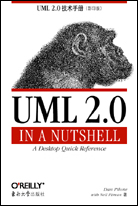
UML 2.0技术手册(影印版)
出版时间:2006年04月
页数:216
你是否曾被类图间箭头的区别所困惑? 是否曾被矩形图的折角所迷惑?是否曾在面对交互图时困惑不解?统一建模语言(UML), 作为一种表达力丰富的描述语言,赋予了软件开发可视化描述的能力,能帮你解除上述的苦恼。但如果你不能真正理解其中符号的意义并熟练运用UML框图的话,UML所特有的这种描述能力也就不能得到充分展现。只有所有参与开发的团队成员对UML的理解达成共识,UML才能成为团队交流的桥梁。
1799年罗赛塔石碑的发现让历史学家揭开了迷惑他们几个世纪的象形文字之谜。作为软件开发人员,我们是幸运的,不用再经历那么长的等待。在《UML 2.0技术手册》一书中,作者Dan Pilone和Neil Pitman不但清楚地描述了UML语言的语法和语义,而且将最新版本的UML 2.0完整地呈现在我们面前。本书主要涵盖以下内容:
●框图的主要类型,包括类图、用例图、复合结构图、交互图等
●各个框图中所使用的不同符号、标记和连线类型的含义
●每个框图最善于表达的信息类别
●如何运用标记值、模板(stereotype)和UML配置文件(profile)为特定的应用领域定制UML
●如何使用对象约束语言
●许多使用UML语言的实用技巧
本书为UML使用手册,同时也可作为UML初学者的入门教材。在使用UML语言的软件开发中它将是你的必备指南。让这本书成为你UML旅途上的罗赛塔石碑吧。
Dan Pilone —— Blueprint Technologies公司的软件架构师。他设计的系统为Hughes,ARINC,UPS和Naval Research Laboratory所广泛使用。
Neil Pitman —— Mahjong Mania公司CTO,具有20年的大型系统开发经验。
1799年罗赛塔石碑的发现让历史学家揭开了迷惑他们几个世纪的象形文字之谜。作为软件开发人员,我们是幸运的,不用再经历那么长的等待。在《UML 2.0技术手册》一书中,作者Dan Pilone和Neil Pitman不但清楚地描述了UML语言的语法和语义,而且将最新版本的UML 2.0完整地呈现在我们面前。本书主要涵盖以下内容:
●框图的主要类型,包括类图、用例图、复合结构图、交互图等
●各个框图中所使用的不同符号、标记和连线类型的含义
●每个框图最善于表达的信息类别
●如何运用标记值、模板(stereotype)和UML配置文件(profile)为特定的应用领域定制UML
●如何使用对象约束语言
●许多使用UML语言的实用技巧
本书为UML使用手册,同时也可作为UML初学者的入门教材。在使用UML语言的软件开发中它将是你的必备指南。让这本书成为你UML旅途上的罗赛塔石碑吧。
Dan Pilone —— Blueprint Technologies公司的软件架构师。他设计的系统为Hughes,ARINC,UPS和Naval Research Laboratory所广泛使用。
Neil Pitman —— Mahjong Mania公司CTO,具有20年的大型系统开发经验。
- Preface
- 1. Fundamentals of UML
- Getting Started
- Background
- UML Basics
- UML Specifications
- Putting UML to Work
- Modeling
- UML Rules of Thumb
- 2. Class Diagrams
- Classes
- Attributes
- Operations
- Methods
- Abstract Classes
- Relationships
- Interfaces
- Templates
- Variations on Class Diagrams
- 3. Package Diagrams
- Representation
- Visibility
- Importing and Accessing Packages
- Merging Packages
- Variations on Package Diagrams
- 4. Composite Structures
- Composite Structures
- Collaborations
- Collaboration Occurrences
- 5. Component Diagrams
- Components
- Component Views
- 6. Deployment Diagrams
- Artifacts
- Nodes
- Deployment
- Variations on Deployment Diagrams
- 7. Use Case Diagrams
- Use Cases
- Actors
- Advanced Use Case Modeling
- Use Case Scope
- 8. Statechart Diagrams
- Behavioral State Machines
- States
- State Machine Extension
- Protocol State Machines
- Pseudostates
- Event Processing
- Variations on Statechart Diagrams
- 9. Activity Diagrams
- Activities and Actions
- Tokens
- Activity Nodes
- Advanced Activity Modeling
- 10. Interaction Diagrams
- What Are Interactions?
- Interaction Participants
- Messages
- Execution Occurrences
- State Invariants
- Event Occurrences
- Traces
- Combined Fragments
- Interaction Occurrences
- Decomposition
- Continuations
- Sequence Timing
- Alternate Interaction Notations
- 11. Tagged Values, Stereotypes, and UML Profiles
- Modeling and UML in Context
- Stereotypes
- Tagged Values
- Constraints
- UML Profiles
- Tools and How They Use Profiles
- 12. Effective Diagramming
- Wallpaper Diagrams
- Sprawling Scope
- One Diagram/One Abstraction
- Besides UML
- A. MDA: Model-Driven Architecture
- B. The Object Constraint Language
- Index
书名:UML 2.0技术手册(影印版)
作者:Dan Pilone, Neil Pitman 著
国内出版社:东南大学出版社
出版时间:2006年04月
页数:216
书号:7-5641-0273-X
原版书出版商:O'Reilly Media
The animal on the cover of UML 2.0 in a Nutshell is a chimpanzee (Pan troglodytes).
Chimpanzees use a vast array of facial expressions,postures,and gestures
to communicate with each other, in addition to at least 32 different sounds. There is some evidence to suggest that chimpanzees can learn symbolic languages.
The natural habitat of the chimpanzee is western Africa, from Sierra Leone to the
Great Lakes east of the Congo. Living primarily in forested areas, chimpanzees
spend 50 to 70 percent of their time in trees. They are omnivores, eating primarily fruits and vegetables, but they will also hunt and eat small animals. They live in family groups that consist of about twice as many females as males. While adult chimpanzees aren't monogamous, there's a close bond between a young chimp and its parents, and this bond remains unbroken for life. Chimpanzees are very sociable and affectionate animals,and frequently hug,kiss,stroke each other,or
hold hands.Violent fights often break out within a social group. The loser of the
fight makes up to the winner by displaying submissive behavior and conciliatory gestures. In this way they maintain the social harmony.
Though able to,the chimpanzee rarely walks erect on both feet.Short arm
muscles prevent simultaneous extension of the wrists and fingers.Because of this,
chimpanzees can't walk with their hands flat; when walking on all fours,only the
knuckles of their hands touch the ground. Unlike human feet, chimpanzee feet
also have an opposing toe, but it's used mainly for climbing and for walking on
precarious footing. The foot is rarely used for picking up objects.
Chimpanzees use a vast array of facial expressions,postures,and gestures
to communicate with each other, in addition to at least 32 different sounds. There is some evidence to suggest that chimpanzees can learn symbolic languages.
The natural habitat of the chimpanzee is western Africa, from Sierra Leone to the
Great Lakes east of the Congo. Living primarily in forested areas, chimpanzees
spend 50 to 70 percent of their time in trees. They are omnivores, eating primarily fruits and vegetables, but they will also hunt and eat small animals. They live in family groups that consist of about twice as many females as males. While adult chimpanzees aren't monogamous, there's a close bond between a young chimp and its parents, and this bond remains unbroken for life. Chimpanzees are very sociable and affectionate animals,and frequently hug,kiss,stroke each other,or
hold hands.Violent fights often break out within a social group. The loser of the
fight makes up to the winner by displaying submissive behavior and conciliatory gestures. In this way they maintain the social harmony.
Though able to,the chimpanzee rarely walks erect on both feet.Short arm
muscles prevent simultaneous extension of the wrists and fingers.Because of this,
chimpanzees can't walk with their hands flat; when walking on all fours,only the
knuckles of their hands touch the ground. Unlike human feet, chimpanzee feet
also have an opposing toe, but it's used mainly for climbing and for walking on
precarious footing. The foot is rarely used for picking up objects.
购买选项
|
© 2025,奥莱利技术咨询(北京)有限公司。版权所有。 传真: +86-10-88097463 京ICP备05003502号 |
|