
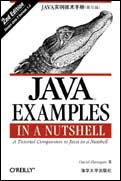
JAVA实例技术手册(第二版,影印版)
出版时间:2003年11月
页数:588
本书完全由实际的Java程序实例构成,内容涉及Java 1.3,包含了164个完整、实用的实例:超过17900行的代码注释涵盖了20种不同的Java API,包括servlet、JSP、XML、Swing和Java 2D。最畅销的《Java in a Nutshell》的作者亲自编写了本书所有的实例代码,读者可以从中学习Java语言,也可以对这些代码进行修改为自己所用。如果你喜欢按照实例去学习,那么本书正是你的最佳选择!
本书是《Java in a Nutshell》、《Java Foundation Classes in a Nutshell》和《Java Enterprise in a Nutshell》的姐妹篇。尽管这三本书属于速查手册,但其中仍然对各种Java主题提供了速成指南。而本书则是弥补这些书所遗漏的一些内容,为Java新手提供了一系列的实例代码,当然,这些代码对于那些经验丰富的编程老手来说也同样适用。本书并没有限制读者的发挥,或仅仅对Java的语法或方法调用进行详细的解释,而是展示了一些具有完美注释的优秀代码实例,从而帮助读者最大程度地认识Java。本书的每一章都包含了编程练习,有助于读者巩固所学到的知识。
本书涵盖的主题包括:
* 用来阐述基本Java功能和关键API的实例,包括I/O、线程、网络、安全、映像和串行化。
* 使用图形用户界面和Java图形特性的程序,重点介绍的是Swing、Java 2D、打印、数据传输、JavaBeans和applet API。
* 用来解释关键性企业级API的实例,包括远程方法调用、数据库连接、servlet、JSP和XML。
本书最后附带了一个实例索引,使读者能够方便地找到编程概念或Java类,也能够方便地找到用于阐述某个概念或使用了某个类的实例。
本书是《Java in a Nutshell》、《Java Foundation Classes in a Nutshell》和《Java Enterprise in a Nutshell》的姐妹篇。尽管这三本书属于速查手册,但其中仍然对各种Java主题提供了速成指南。而本书则是弥补这些书所遗漏的一些内容,为Java新手提供了一系列的实例代码,当然,这些代码对于那些经验丰富的编程老手来说也同样适用。本书并没有限制读者的发挥,或仅仅对Java的语法或方法调用进行详细的解释,而是展示了一些具有完美注释的优秀代码实例,从而帮助读者最大程度地认识Java。本书的每一章都包含了编程练习,有助于读者巩固所学到的知识。
本书涵盖的主题包括:
* 用来阐述基本Java功能和关键API的实例,包括I/O、线程、网络、安全、映像和串行化。
* 使用图形用户界面和Java图形特性的程序,重点介绍的是Swing、Java 2D、打印、数据传输、JavaBeans和applet API。
* 用来解释关键性企业级API的实例,包括远程方法调用、数据库连接、servlet、JSP和XML。
本书最后附带了一个实例索引,使读者能够方便地找到编程概念或Java类,也能够方便地找到用于阐述某个概念或使用了某个类的实例。
- Preface
- Part I: Core Java APIs
- Chapter 1 Java Basics
- Hello World
- FizzBuzz
- The Fibonacci Series
- Using Command-Line Arguments
- Echo in Reverse
- FizzBuzz Switched
- Computing Factorials
- Recursive Factorials
- Caching Factorials
- Computing Big Factorials
- Handling Exceptions
- Interactive Input
- Using a StringBuffer
- Sorting Numbers
- Computing Primes
- Exercises
- Chapter 2 Objects, Classes, and Interfaces
- A Rectangle Class
- Testing the Rect Class
- A Rect Subclass
- Another Subclass
- Complex Numbers
- Computing Pseudo-Random Numbers
- Computing Statistics
- A Linked List Class
- Advanced Sorting
- Exercises
- Chapter 3 Input/Output
- Files and Streams
- Working with Files
- Copying File Contents
- Reading and Displaying Text Files
- Listing Directory and File Information
- Compressing Files and Directories
- Filtering Character Streams
- Filtering Lines of Text
- A Custom HTML Output Stream
- Exercises
- Chapter 4 Threads
- Thread Basics
- Threads and Thread Groups
- Deadlock
- Timers
- Exercises
- Chapter 5 Networking
- Downloading the Contents of a URL
- Using a URLConnection
- Sending Email Through a URLConnection
- Connecting to a Web Server
- A Simple Web Server
- A Proxy Server
- Networking with Applets
- A Generic Client
- A Generic Multithreaded Server
- A Multithreaded Proxy Server
- Sending Datagrams
- Receiving Datagrams
- Exercises
- Chapter 6 Security and Cryptography
- Running Untrusted Code
- Loading Untrusted Code
- Message Digests and Digital Signatures
- Cryptography
- Exercises
- Chapter 7 Internationalization
- A Word About Locales
- Unicode
- Character Encodings
- Handling Local Customs
- Localizing User-Visible Messages
- Formatted Messages
- Exercises
- Chapter 8 Reflection
- Obtaining Class and Member Information
- Invoking a Named Method
- Exercises
- Chapter 9 Object Serialization
- Simple Serialization
- Custom Serialization
- Externalizable Classes
- Serialization and Class Versioning
- Serialized Applets
- Exercises
- Part II: Graphics and GUIs
- Chapter 10 Graphical User Interfaces
- Components
- Containers
- Layout Management
- Event Handling
- A Complete GUI
- Actions and Reflection
- Custom Dialogs
- Displaying Tables
- Displaying Trees
- A Simple Web Browser
- Describing GUIs with Properties
- Themes and the Metal Look-and-Feel
- Custom Components
- Exercises
- Chapter 11 Graphics
- Graphics Before Java 1.2
- The Java 2D API
- Drawing and Filling Shapes
- Transforms
- Line Styles with BasicStroke
- Stroking Lines
- Filling Shapes with Paint
- Antialiasing
- Combining Colors with AlphaComposite
- Image Processing
- A Custom Shape
- Custom Strokes
- Custom Paint
- Advanced Animation
- Displaying Graphics Examples
- Exercises
- Chapter 12 Printing
- Printing with the Java 1.1 API
- Printing with the Java 1.2 API
- Printing Multipage Text Documents
- Printing Swing Documents
- Exercises
- Chapter 13 Data Transfer
- Data Transfer Architecture
- Simple Copy-and-Paste
- A Transferable Data Type
- Cutting and Pasting Scribbles
- Dragging and Dropping Scribbles
- Exercises
- Chapter 14 JavaBeans
- Bean Basics
- A Simple Bean
- A More Complex Bean
- Custom Events
- Specifying Bean Information
- Defining a Simple Property Editor
- Defining a Complex Property Editor
- Defining a Bean Customizer
- Exercises
- Chapter 15 Applets
- Introduction to Applets
- A First Applet
- A Clock Applet
- Applets and the Java 1.0 Event Model
- Java 1.0 Event Details
- Reading Applet Parameters
- Images and Sounds
- JAR Files
- Exercises
- Part III: Enterprise Java
- Chapter 16 Remote Method Invocation
- Remote Banking
- A Bank Server
- A Multiuser Domain
- Remote MUD Interfaces
- The MUD Server
- The MudPlace Class
- The MudPerson Class
- A MUD Client
- Advanced RMI
- Exercises
- Chapter 17 Database Access with SQL
- Accessing a Database
- Using Database Metadata
- Building a Database
- Using the API Database
- Atomic Transactions
- Exercises
- Chapter 18 Servlets and JSP
- Servlet Setup
- A Hello World Servlet
- Servlet Initialization and Persistence: A Counter Servlet
- Database Access with Servlets
- A Login Screen with JSP
- Request Forwarding
- JSP Pages and JavaBeans
- Ending a User Session
- Custom Tags
- Deploying a Web Application
- Exercises
- Chapter 19 XML
- Parsing with JAXP and SAX 1
- Parsing with SAX 2
- Parsing and Manipulating with JAXP and DOM
- Traversing a DOM Tree
- Traversing a Document with DOM Level 2
- The JDOM API
- Exercises
- Chapter 20 Example Index
- Index
书名:JAVA实例技术手册(第二版,影印版)
作者:David Flanagan 著
国内出版社:清华大学出版社
出版时间:2003年11月
页数:588
书号:7-302-06751-1
原版书出版商:O'Reilly Media
The animal of this book is an alligator. There are only two species of alligator: the American alligator (Alligator
mississippiensis), found in the southeastern coastal plain of the United States, and the smaller Chinese alligator (Alligator sinensis), found in the lower valley of the
Yangtze River. Both alligators are related to the more widely distributed crocodile.
The alligator is a much-studied animal, and so a great deal is known about its life
cycle. Female alligators lay 30 to 80 eggs at a time. The mother allows the sun to
incubate the eggs, but stays nearby. After about 60 days the eggs hatch, and the
young call out for their mother. The mother then carries or leads them to the water,
where they live with her for a year.
Alligators eat a varied diet of insects, fish, shellfish, frogs, water birds, and small
mammals. Alligator attacks on humans are rare. Although normally slow-moving ani-mals,
alligators can charge quickly for short distances when they or their young are
in danger.
Alligators have been hunted extensively for their skin. The American alligator was
placed on the endangered species list in 1969, then declared to be out of danger in
1987. The Chinese alligator remains on the endangered list.
mississippiensis), found in the southeastern coastal plain of the United States, and the smaller Chinese alligator (Alligator sinensis), found in the lower valley of the
Yangtze River. Both alligators are related to the more widely distributed crocodile.
The alligator is a much-studied animal, and so a great deal is known about its life
cycle. Female alligators lay 30 to 80 eggs at a time. The mother allows the sun to
incubate the eggs, but stays nearby. After about 60 days the eggs hatch, and the
young call out for their mother. The mother then carries or leads them to the water,
where they live with her for a year.
Alligators eat a varied diet of insects, fish, shellfish, frogs, water birds, and small
mammals. Alligator attacks on humans are rare. Although normally slow-moving ani-mals,
alligators can charge quickly for short distances when they or their young are
in danger.
Alligators have been hunted extensively for their skin. The American alligator was
placed on the endangered species list in 1969, then declared to be out of danger in
1987. The Chinese alligator remains on the endangered list.
购买选项
|
© 2024,奥莱利技术咨询(北京)有限公司。版权所有。 传真: +86-10-88097463 京ICP备05003502号 |
|