
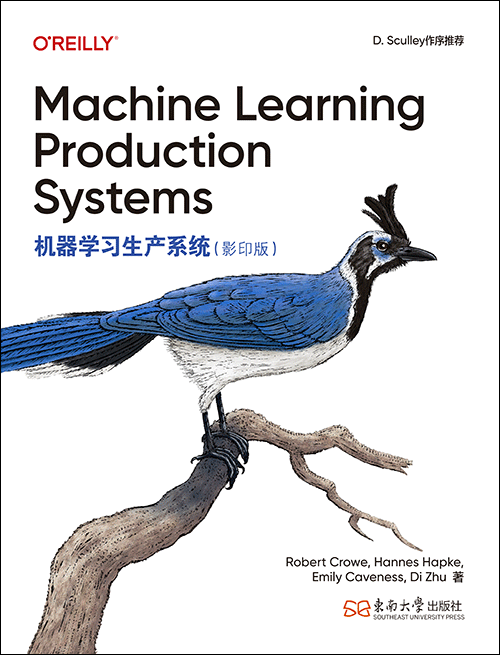
机器学习生产系统(影印版)
出版时间:2025年04月
页数:445
“一本全面详实的书籍,为你提供了在生产环境中构建、部署、管理机器学习系统的完整流程。本书涵盖了你需要了解的方方面面,从充分利用数据,到训练模型,再到将这些模型部署到可扩展的基础设施上,以及管理细节,以确保系统的平稳运行。”
——Laurence Moroney
AI顾问、教师、作者
机器学习(ML)和人工智能(AI)领域正在蓬勃发展,几乎每天都有新的研究、模型和技术出现。面对如此丰富的选择,数据科学家、机器学习工程师和软件开发人员很容易迷失在将AI/ML模型从实验阶段推向生产的众多步骤中。
这本实用书籍专注于生产环境机器学习,指导你将ML模型转化为可行的产品和应用。生产环境机器学习涵盖了ML的所有领域,不仅限于简单的模型训练。本书特别强调了ML流水线,帮助你为ML生产系统奠定基础。
你即将开启探索之旅,学习将ML应用投入生产所需的广泛技术,以及需要考虑的问题和方法。关键的ML工程主题包括:
● 数据收集、验证、存储、特征工程
● 模型分析、服务、监控、日志记录
● 使用TensorFlow Extended(TFX)和其他工具编排机器学习流水线
本书提供了深入的实例,包括适用于自然语言处理(NLP)和计算机视觉模型的端到端机器学习流水线。
——Laurence Moroney
AI顾问、教师、作者
机器学习(ML)和人工智能(AI)领域正在蓬勃发展,几乎每天都有新的研究、模型和技术出现。面对如此丰富的选择,数据科学家、机器学习工程师和软件开发人员很容易迷失在将AI/ML模型从实验阶段推向生产的众多步骤中。
这本实用书籍专注于生产环境机器学习,指导你将ML模型转化为可行的产品和应用。生产环境机器学习涵盖了ML的所有领域,不仅限于简单的模型训练。本书特别强调了ML流水线,帮助你为ML生产系统奠定基础。
你即将开启探索之旅,学习将ML应用投入生产所需的广泛技术,以及需要考虑的问题和方法。关键的ML工程主题包括:
● 数据收集、验证、存储、特征工程
● 模型分析、服务、监控、日志记录
● 使用TensorFlow Extended(TFX)和其他工具编排机器学习流水线
本书提供了深入的实例,包括适用于自然语言处理(NLP)和计算机视觉模型的端到端机器学习流水线。
- Foreword
- Preface
- 1. Introduction to Machine Learning Production Systems
- What Is Production Machine Learning?
- Benefits of Machine Learning Pipelines
- When to Use Machine Learning Pipelines
- Steps in a Machine Learning Pipeline
- Looking Ahead
- 2. Collecting, Labeling, and Validating Data
- Important Considerations in Data Collection
- Responsible Data Collection
- Labeling Data: Data Changes and Drift in Production ML
- Labeling Data: Direct Labeling and Human Labeling
- Validating Data: Detecting Data Issues
- Validating Data: TensorFlow Data Validation
- Example: Spotting Imbalanced Datasets with TensorFlow Data Validation
- Conclusion
- 3. Feature Engineering and Feature Selection
- Introduction to Feature Engineering
- Preprocessing Operations
- Feature Engineering Techniques
- Feature Transformation at Scale
- Using TensorFlow Transform
- Feature Selection
- Example: Using TF Transform to Tokenize Text
- Conclusion
- 4. Data Journey and Data Storage
- Data Journey
- ML Metadata
- Using a Schema
- Enterprise Data Storage
- Conclusion
- 5. Advanced Labeling, Augmentation, and Data Preprocessing
- Advanced Labeling
- Data Augmentation
- Preprocessing Time Series Data: An Example
- Conclusion
- 6. Model Resource Management Techniques
- Dimensionality Reduction: Dimensionality Effect on Performance
- Quantization and Pruning
- Knowledge Distillation
- Conclusion
- 7. High-Performance Modeling
- Distributed Training
- Efficient Input Pipelines
- Training Large Models: The Rise of Giant Neural Nets and Parallelism
- Conclusion
- 8. Model Analysis
- Analyzing Model Performance
- Advanced Model Analysis
- Advanced Model Debugging
- Model Remediation
- Discrimination Remediation
- Fairness
- Continuous Evaluation and Monitoring
- Conclusion
- 9. Interpretability
- Explainable AI
- Model Interpretation Methods
- Example: Exploring Model Sensitivity with SHAP
- Conclusion
- 10. Neural Architecture Search
- Hyperparameter Tuning
- Introduction to AutoML
- Key Components of NAS
- AutoML in the Cloud
- Using AutoML
- Generative AI and AutoML
- Conclusion
- 11. Introduction to Model Serving
- Model Training
- Model Prediction
- Latency
- Throughput
- Cost
- Resources and Requirements for Serving Models
- Model Deployments
- Model Servers
- Managed Services
- Conclusion
- 12. Model Serving Patterns
- Batch Inference
- Introduction to Real-Time Inference
- Real-Time Inference Use Cases
- Serving Model Ensembles
- Data Preprocessing and Postprocessing in Real Time
- Inference at the Edge and at the Browser
- Conclusion
- 13. Model Serving Infrastructure
- Model Servers
- Building Scalable Infrastructure
- Containerization
- Reliability and Availability Through Redundancy
- Hardware Accelerators
- Conclusion
- 14. Model Serving Examples
- Example: Deploying TensorFlow Models with TensorFlow Serving
- Example: Profiling TF Serving Inferences with TF Profiler
- Example: Basic TorchServe Setup
- Conclusion
- 15. Model Management and Delivery
- Experiment Tracking
- Introduction to MLOps
- MLOps Methodology
- Three Types of Custom Components
- TFX Deep Dive
- Managing Model Versions
- Continuous Integration and Continuous Deployment
- Progressive Delivery
- Conclusion
- 16. Model Monitoring and Logging
- The Importance of Monitoring
- Observability in Machine Learning
- Logging
- Distributed Tracing
- Monitoring for Model Decay
- Retraining Your Model
- Conclusion
- 17. Privacy and Legal Requirements
- Why Is Data Privacy Important?
- Legal Requirements
- Pseudonymization and Anonymization
- Differential Privacy
- Federated Learning
- Encrypted ML
- Conclusion
- 18. Orchestrating Machine Learning Pipelines
- An Introduction to Pipeline Orchestration
- Pipeline Orchestration with TFX
- Orchestrating TFX Pipelines with Apache Beam
- Orchestrating TFX Pipelines with Kubeflow Pipelines
- Google Cloud Vertex Pipelines
- Choosing Your Orchestrator
- Alternatives to TFX
- Conclusion
- 19. Advanced TFX
- Advanced Pipeline Practices
- Custom TFX Components: Architecture and Use Cases
- Using Function-Based Custom Components
- Writing a Custom Component from Scratch
- Implementation Review
- Reusing Existing Components
- Creating Container-Based Custom Components
- Which Custom Component Is Right for You?
- TFX-Addons
- Conclusion
- 20. ML Pipelines for Computer Vision Problems
- Our Data
- Our Model
- Custom Ingestion Component
- Data Preprocessing
- Exporting the Model
- Our Pipeline
- Executing on Apache Beam
- Executing on Vertex Pipelines
- Model Deployment with TensorFlow Serving
- Conclusion
- 21. ML Pipelines for Natural Language Processing
- Our Data
- Our Model
- Ingestion Component
- Data Preprocessing
- Putting the Pipeline Together
- Executing the Pipeline
- Model Deployment with Google Cloud Vertex
- Conclusion
- 22. Generative AI
- Generative Models
- GenAI Model Types
- Agents and Copilots
- Pretraining
- Fine-Tuning
- Parameter-Efficient Fine-Tuning
- Human Alignment
- Prompting
- Chaining
- Retrieval Augmented Generation
- ReAct
- Evaluation
- LMOps
- GenAI Attacks
- Responsible GenAI
- Conclusion
- 23. The Future of Machine Learning Production Systems and Next Steps
- Let’s Think in Terms of ML Systems, Not ML Models
- Bringing ML Systems Closer to Domain Experts
- Privacy Has Never Been More Important
- Conclusion
- Index
书名:机器学习生产系统(影印版)
国内出版社:东南大学出版社
出版时间:2025年04月
页数:445
书号:978-7-5766-2005-4
原版书书名:Machine Learning Production Systems
原版书出版商:O'Reilly Media
The animal on the cover of Machine Learning Production Systems is a black-throated magpie-jay (Calocitta colliei), a striking, intelligent bird species in the Corvidae, or crow, family native to Mexico’s Baja Peninsula. Black-throated magpie-jays have long, blue tail feathers. An average adult grows to about 26.6 inches in total length and 8.8 ounces. These birds can live up to 20 years.
In 2019, the IUCN Red List found that the population of black-throated magpie-jays is decreasing, but not threatened. Many of the animals on O’Reilly covers are endangered; all of them are important to the world.
In 2019, the IUCN Red List found that the population of black-throated magpie-jays is decreasing, but not threatened. Many of the animals on O’Reilly covers are endangered; all of them are important to the world.
购买选项
|
© 2026,奥莱利技术咨询(北京)有限公司。版权所有。 传真: +86-10-88097463 京ICP备05003502号 |
|